The Difficulty of the topic
Art about Environmentalism and climate change is in, and has been for the last couple of decades. It is natural for an artist to wish to depict the world they see, and the issues that draw emotion from them. Throughout history many of the greatest artworks have been inspired by anger or societal frustration. Dramatic images like The Raft of The Medusa (1818) very clearly depict suffering. It was painted as a direct expression of anger at the corruption that had led to death. With The Raft Of The Medusa the suffering is easy to point to, it’s the piles of dead and dying in the painting, and the cause was easily pointed to in the newspapers of the time, the French government.
Painting environmental anger and frustration however, is much more awkward. When looking at this I am reminded of Shawn Grenier’s brilliant video on the painting “Worn Out”. He described how the work depicts a murder, not one of the straight forward “victim and perpetrator” kind like the Raft of the Medusa, but a societal one of a farm labourer worked into exhaustion and collapse, killed by the system not by an individual. I personally love the massive 7 metre squared work Worn Out. The enormous canvas lends itself well to making the large characters feel more human, but also small when hunched in such a vast expanse of farmland. All of this is to say that I think Brendekilde, if he were alive today, would be very good at making Climate art, but that it takes a brilliant artist like himself to do so.
Below I share some climate art that you as the reader are very welcome to like, and to disagree with me on, but that I think is bland. Please allow me to defend myself. I think all of these pieces are good to look at for 10 seconds and you’ll think “oh that’s a fun idea” or “what skilled painting that is” but that’s where it ends, you’re done with it after that. The point that humans are damaging our environment is so well covered that if that’s the main thing a piece is really saying, it struggles to say anything. This is not a major critique of these artists, but an observation on the difficulty of making deep environmental art.
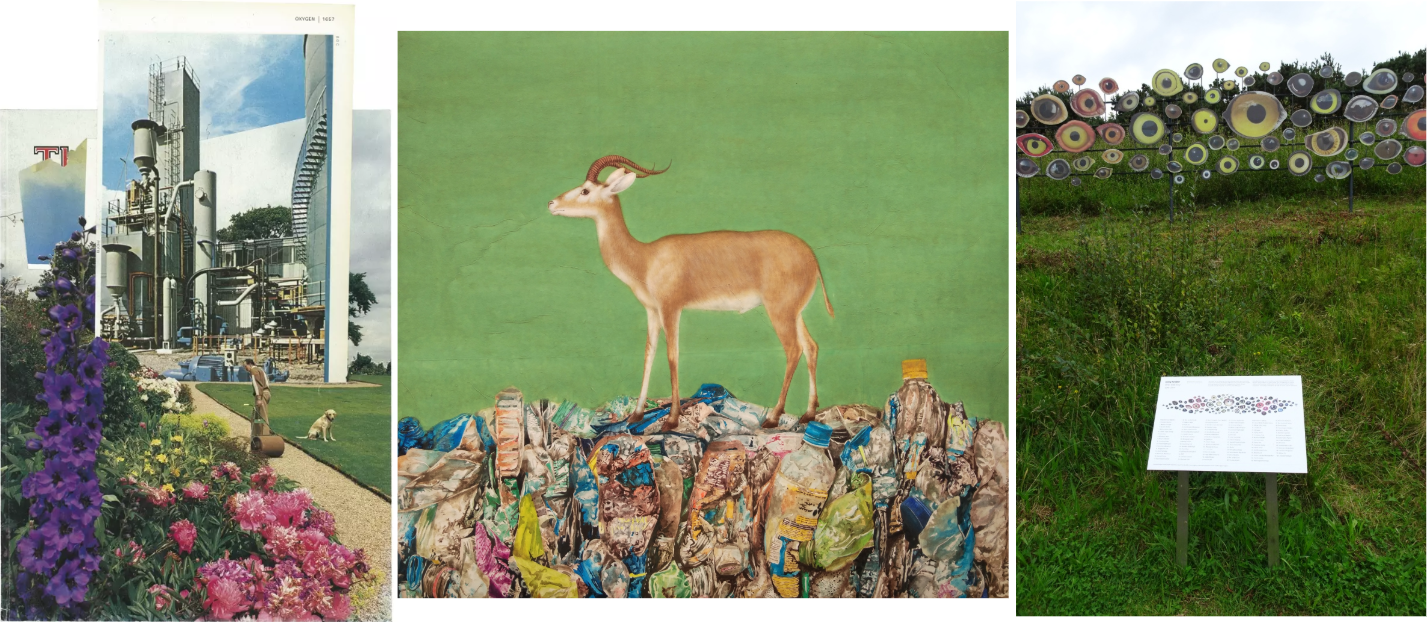
In order: Oxygen 1657 - Benjamin West, Returning Life - Tapas Das, Birds Watching - Jenny Kendler. I don’t wish to single out these artists specifically, just provide a few examples to illustrate why I think greatness is difficult
Great works like Worn Out are best when you spend time with them to sit and absorb her last emotions before the fall, ponder the old man’s life, whose fault this is, and the vast empty loneliness of the field. Although producing a climate piece like this is possible, I find many pieces like those above don’t give me space to think and ask questions. It’s a simple punch in the face announcing human damage is bad, which it is but if you can’t keep me interested in your piece for more than 20 seconds you’ve lost the battle of the artist.
Yao Lu - The Brilliant
You will notice this article is titled with a man’s name, a man who I have not mentioned once yet, which I appreciate is a little strange. Yao Lu is a Chinese photographer and editor who’s still actively working. Despite the time I have just spent putting down people far more skilled than I in the last montage, I primarily want to talk about someone who I feel got it so so right. When I first accidentally stumbled onto his work scrolling down a webpage, I just froze mouse-in–hand and stared. I do think however, I must give Yao Lu’s works some more context before showing (I will talk a lot more about contextualising art in a future post).
First is an appreciation of what traditional Chinese art looks like (the classic form of Chinese art, known as guó huà). Yao Lu’s use of fog and seemingly floating disembodied mountains is able to invoke this style by sharing the tendency in ink wash landscapes to leave regions blank and only include the focal points of interest, like mountains. Most old paintings on paper and silk may have once been light but are now very darkened with age. The range of creamy light browns in Yao Lu’s piece help echo the familiar brown backings of traditional ink wash. When you combine this with stamping his signature in red, you get a modern piece of edited photography, with a familiarity that immediately sends the mind back centuries at first glance.

Ma Yuan - Dancing and Singing Peasant Returning From Work. (Wikipedia Commons) This classic piece shows the above described themes of mountains, blank regions, faded browns and red stamping. Colourful guó huà exists too, but this black and white piece illustrated my points too neatly to leave out.
The next essential point to understand is the rapid growth of construction in China. Any city you visit will have new high-rise construction underway in it. Ubiquitously across Asia, construction is matched with a distinctive Green netting. In 2025 this made the news after improper quality highly flammable netting was used, leading to 159 deaths in a fire in Hong Kong. Usually the netting is discarded as waste once a building is complete. With all this in mind. Here is Yao Lu’s first piece that I stumbled across, that caused me to freeze in my scrolling.
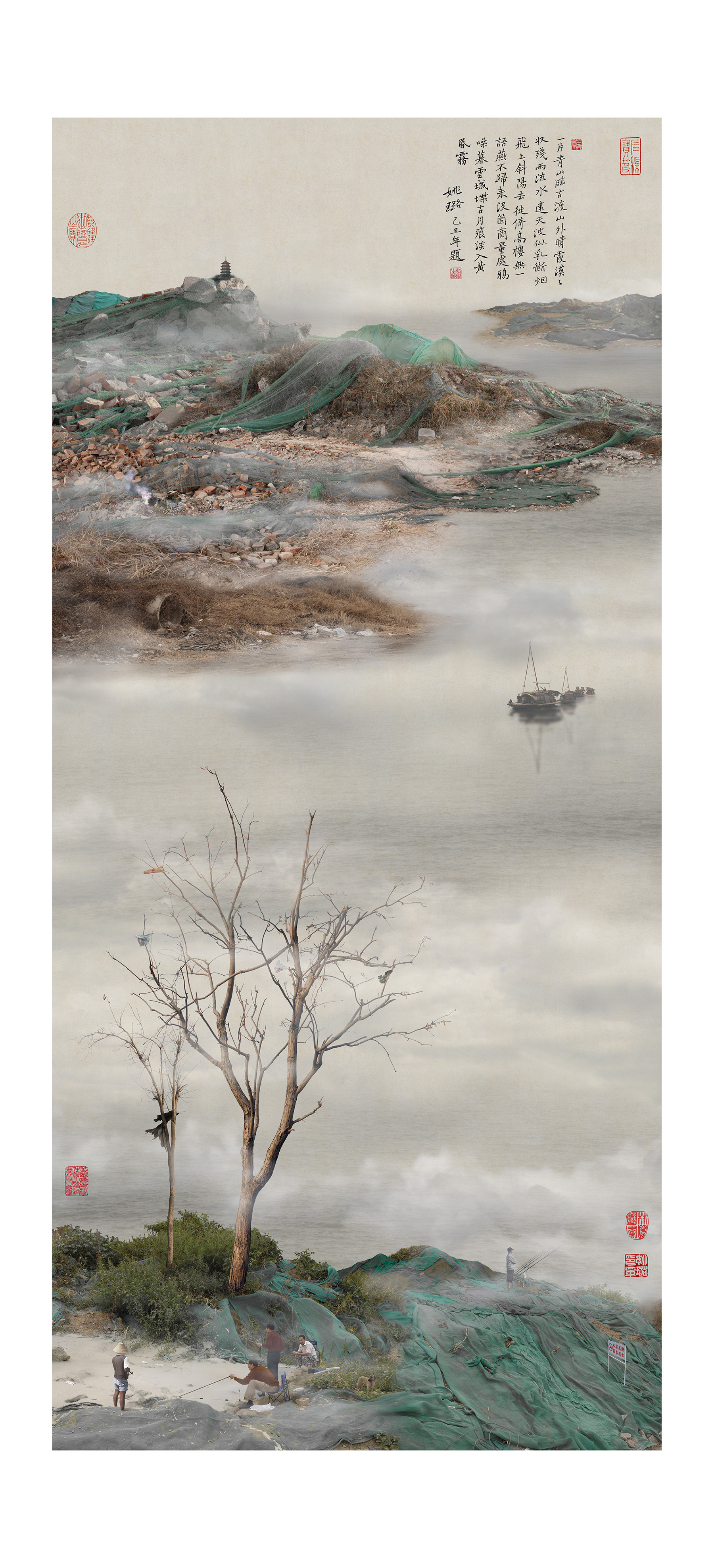
Yao Lu. Passing Spring at the Ancient Dock. 2006. C-print; 85 x 85 cm. Courtesy of the artist. Licensed under Creative Commons Attribution 4.0.
A quick search then led me to this, my clear favourite of his works, Passing Spring at the Ancient Dock.
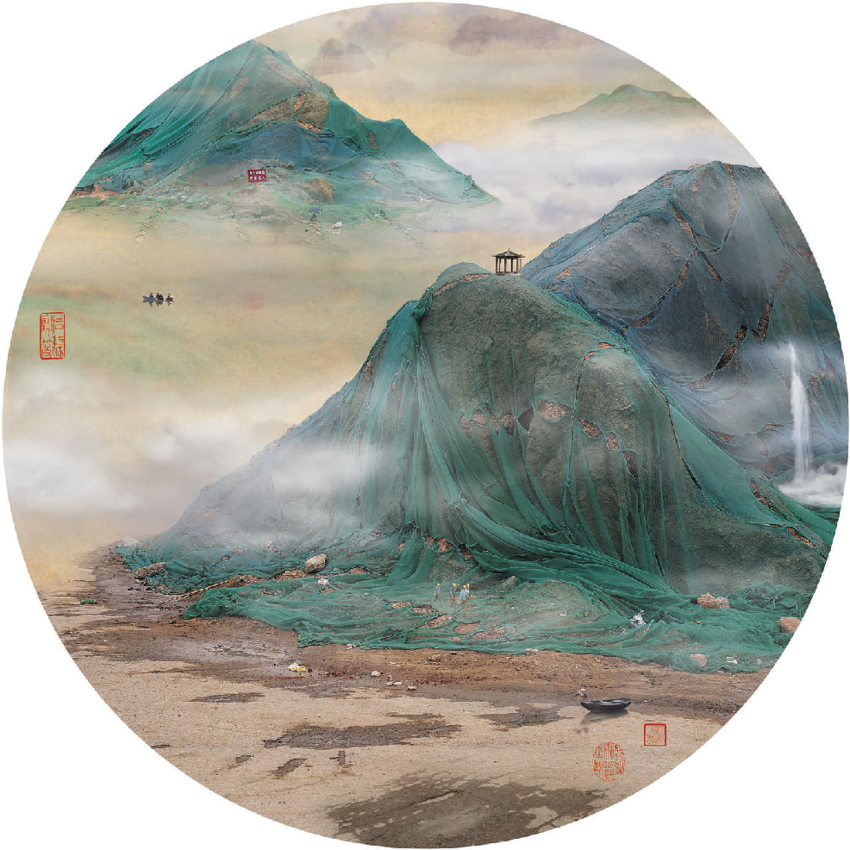
Yao Lu. Passing Spring at the Ancient Dock. 2006. C-print; 85 x 85 cm. Courtesy of the artist. Licensed under Creative Commons Attribution 4.0.
The technical skill and difficulty of this work is subtle, it can be hard to immediately comprehend just how difficult a piece of edited photography can be, compared to the obviously noticeable difficulty in producing a classical painting. Creating an effect, a vague feel rather than a clear thing, is always harder than executing a specific edit. This then scales by 100 times when the thing you’re trying to create is so polarisingly different to your true medium.
The work both doesn’t hide from being edited photography, and is simultaneously instantly recognisable as something that predates the camera, a non-realism focussed traditional Chinese landscape. Combining this technical skill with the creativity of using the netting, construction waste, to replace grass is a touch of genius. A closer look reveals the foreground to be road, not shore. On it sits a traditional rowing boat. At first glance it looks in place ready for use, but the shore being in fact road in this modern dock, leaves it beached and useless. A boat floats on the fog in the distance, a reminder of the dock’s centuries of history, firmly against the mountains of rubble and netting.
This piece is unsubtly anti-waste; against modern development and its associated environmental pollution. But unlike the works I dared to call shallow, these pieces give you room to think and ask questions. Although Passing Spring is my favourite aesthetically, going back to the first piece I encountered (Angling On Low Island) allows me to ask you some questions that I will leave unanswered to demonstrate where you can let your mind go while reflecting upon this piece.
Who caused this? What larger forces created this?
Is the continued fishing despite the act of waste around them, an act of refusal to quit, stoicism, or ignorance as to what their surroundings have become?
Is it a comment on the fact we are degrading the sea as well as the land, through overfishing and pollution?
Are the fishermen… happy?
Will the grass and shrubs visible in the foreground become fully dead and fade from green to brown, like the region in the middle?
The fact that you can argue about the answers to all of these questions is what makes the pieces worth staring at for minutes not seconds. The artist does not punch you in the face with a clear singular narrative, but lets your mind explore the elements of the scene, the elements of the society in which he creates. The art isn’t so vague that it avoids making a point, many of Yao Lu’s environmental viewpoints are laid bare in the work, and that’s important too. Attempting to leave plenty for the viewer to consider and decide themself can lead to being too vague to say anything. Here I personally believe Yao Lu strikes a beautiful balance, to invoke my own Chinese tradition myself, the opposite forces of bluntness and vagary sit in harmony, in Yin and Yang.
Yao Lu - Bringing me back down to earth
I must warn you now quickly at this point in the article that what you see next may ruin your enjoyment. Yao Lu actually has some works that miss the mark so hard for me that they should’ve been in the montage of environmental art that fails to be deep. If you don’t want the great skill of the prior works which we contemplated to be soured, you may need to rapidly abandon this article.
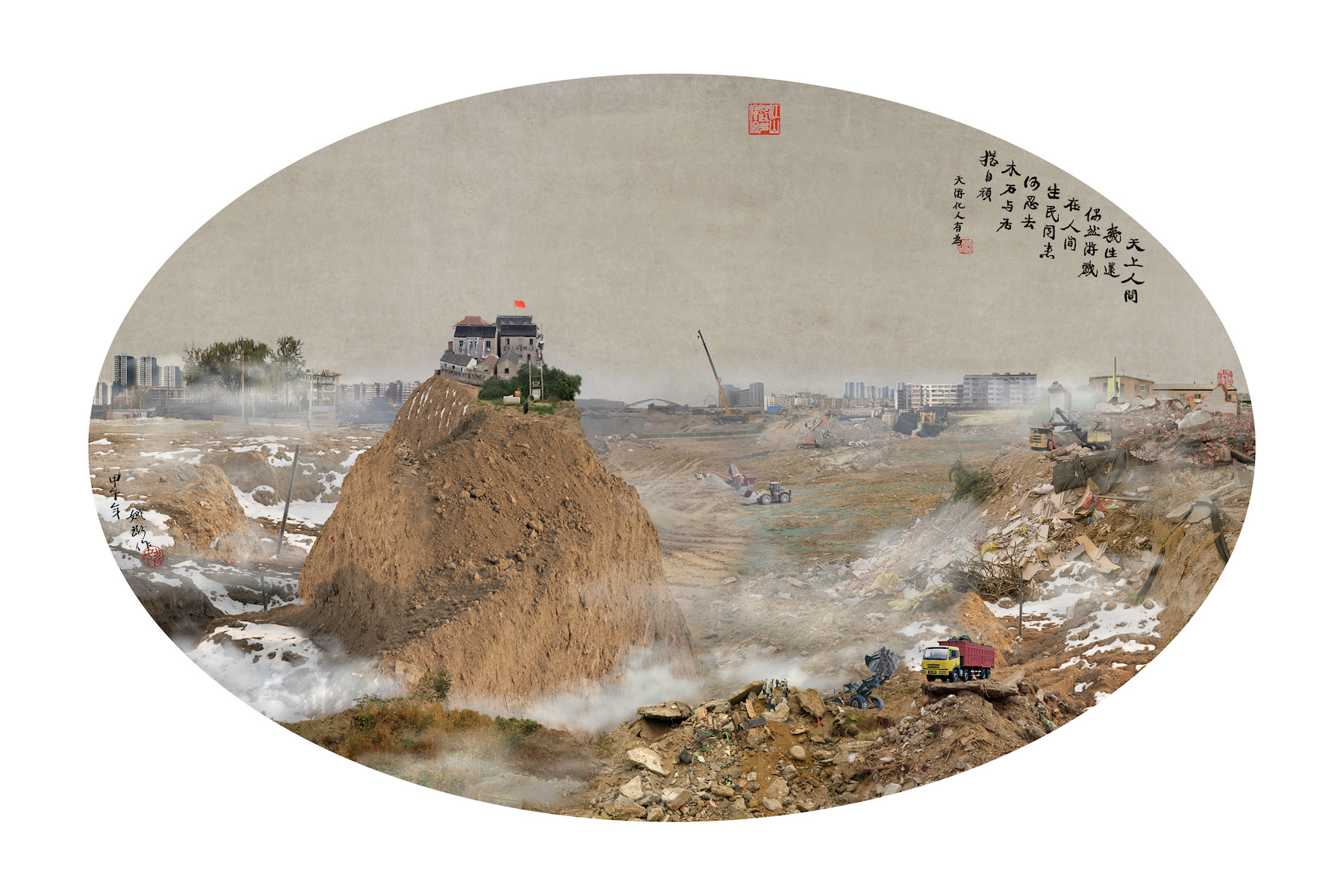
Yao Lu. Heaven on Earth No. 2, 2014.
The editing of the digger and truck in the foreground, the simplicity and bluntness of the concepts, these things make it a shame for me personally to know that the creator of “Passing Spring at the Ancient Dock” also made this. Maybe you like this, you’re allowed to. But for me it makes it harder for me to say I think this guy is a genius who really gets it, how to make environmental art better than the rest, when I know this exists.
I also found it a little bit of a shame to see just how many pieces he has made using the green netting as the core idea. The idea is creatively exquisite, but my suspicions are that he realised this and has tried to milk it for all it’s worth, as his best idea, and consequently the unique beauty of the pieces are slightly diminished by the large collection of similar images, some that I rate higher than others. It gives me a similar feeling to that I have about some classical names like Monet that can be hard to describe. A sort of disappointment that upon finding one thing that really works, they accepted that’s it job done: time to paint the same flowers 250 times. Somehow the existence of Monet’s 250th water lilies painting erodes my enjoyment of the first. While Yao Lu has far fewer than 250 pieces utilising the green netting representing grass, the emotion is similar.
I’m just extremely glad these pieces I really dislike weren’t his first pieces I stumbled upon, else I would not have given his name a second consideration in my searching, and I would never have been gifted the moment of genuine awe I experienced at the first sightings of Passing Spring at the ancient dock, and Angling On Low Island.