You get off a plane, out into the familiar 30-degree heat of Dakar, Senegal. You’re returning from a couple of weeks in the Arctic Circle trialling for Tromsø. You will almost certainly never go back, but your space in a bunk bed at Mawade Wade Football Academy is still available.
This is the reality of football for many. In a Norwegian Language Article, they place the number of Mawade Wade trialists at Tromsø between 5 and 10 a year. One of them was El Hadji Malick Diouf, who signed for Brentford for 40m euros this summer. Most of them are not.
At Mawade Wade, like dozens of other Senegalese academies, players live at the academy. They eat with their teammates. They then go to schools attached to or run by the academy. Many players there are not from the capital, Dakar, but have travelled tens or hundreds of kilometres away from their families for the opportunity to live at their academy. Sadio Mané travelled 400km from his home village of Bambali, south of Gambia, to the Generation Foot academy in Thies, north of Gambia.
In Senegal alone, there are over 400 licensed football academies. Some, like Generation Foot, house close to a hundred prospects, all vying for a plane ticket to FC Metz. Others will have no more than a dozen players and a sand pitch, where the dream of the players is to earn an invite to one of these Europe-Affiliated academies.
The sheer scale of this structure, and its brutality, was something I stumbled onto when seeing Malick Diouf’s career path. I dared to think it quite funny to go from the outskirts of the Sahara straight to the Arctic Circle. It made me realise, though, just how disconnected football fans are from the extraction of talent from Africa. So, I set out to educate myself and understand why it’s not within the knowledge sphere of the normal football fan.
Some subsetting, linking of datasets, and 175,000 transfers as recorded by Transfermarkt, became a complete list of just over 1000 Africa to Europe transfers over the last 20 years. Transfermarkt data is, of course, not fully complete, but especially over the last decade is uniquely extensive.
Who’s Extracting?
I use the term extracting, rather than buying. Many of these academies are funded and therefore functionally owned by the club that has so-called “first refusal” of players. Transfer fees are negligible, or just the vehicle for funding the academy so it can keep providing, so the idea of “buying” is a bit disingenuous, since it’s hard to find a local who has been paid for providing this talent.
I think ‘extracting’ then is better suited to the cold and methodical nature of business. One of the coaches at Mawade Wade speaking to VG credited the desire to escape the cycle of poverty, and provide for their families/villages as one of the core things that makes Senegalese players special.
Ethics aside, whether you wish to view it as opportunity providing, or weaponising the aspirations of the poor, these academies exist, and so does the extraction of talent from domestic self-funded academies/clubs. Enough caveats then. Here are the results:
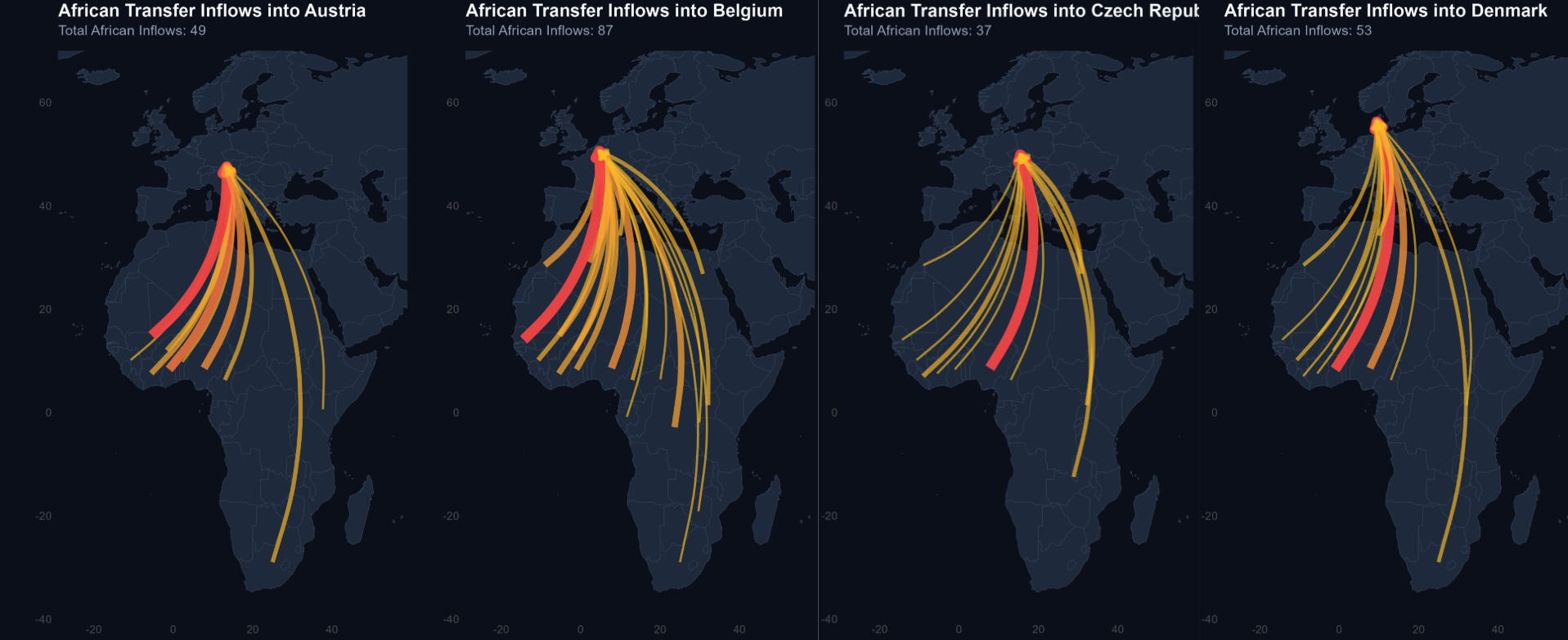
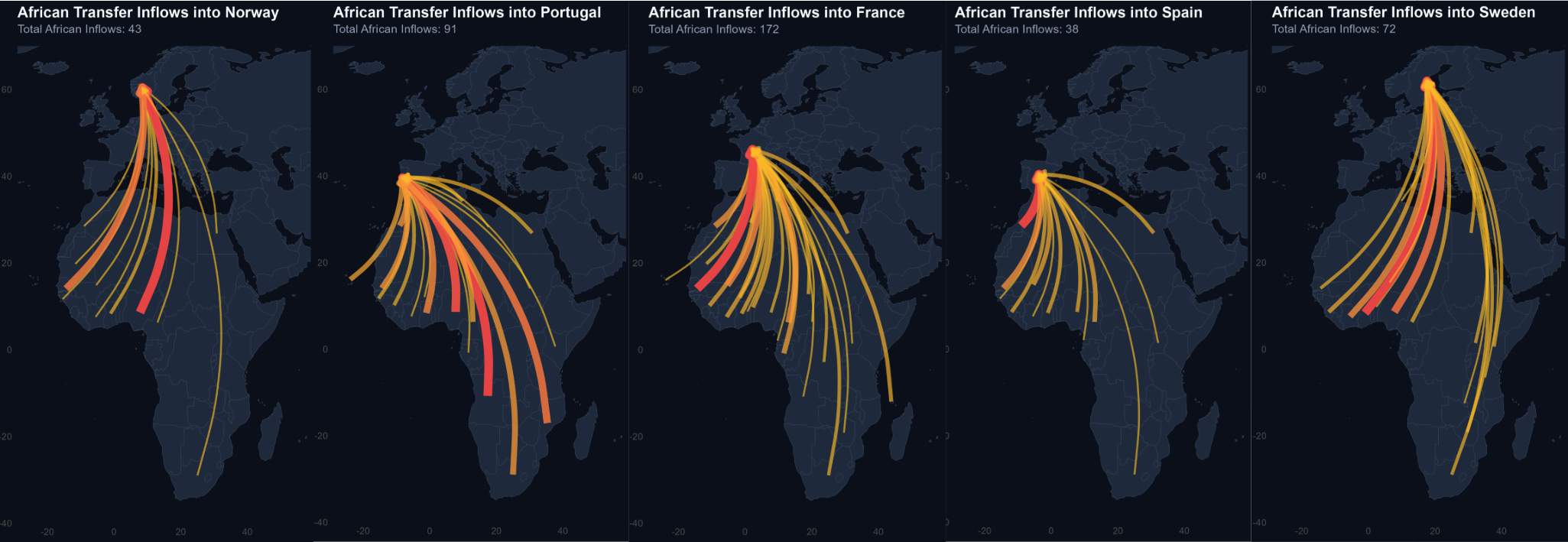
In these plots we see the top 9 extracters of talent from Africa. Each plot shows all the source countries providing to the selected destination. Line thickness and shade correlates to numbers of transfers taken on that specific route. All arrows taken from centroids rather than club/city GPS points.
We see here that France is a real leader in this; we should not be surprised given the number of Francophone former colonies, and France’s own obsession with the game. Portugal and Spain too are major former colonial powers, and football-focused. Looking at the map of inflows to Portugal, you will see their #1 source is Angola, a Portuguese-speaking nation that provides footballing talent to almost no other European nation.
The rest, though, is probably more of a surprise to you unless you live in one of those countries. The Danish, Swedish and Norwegian pipelines are not things the normal fan ever considers, but they are one of the essential routes through which African players reach Europe. In all 3 countries, it’s West African nations specifically that dominate the supply of talent.
When it comes to why these nations engage in this, I’ve calculated 2 numbers that do all the explaining for me.
Total Combined Transfer Fees paid for all Africa->Europe deals: 124,289,000 Euros.
First intra-Europe Sale Fee of these players, combined: 1,746,023,800 Euros.
So far, clubs who scout Africa, and clubs who have African Academy ties (Like Tromsø with Mawade Wade), have made 1.6 billion Euros of profit in player sales just in African Talent. Since it can be so effective, and relatively cheap to run for these clubs, you may be wondering: Why isn’t everyone doing it? Why Austria, but not Germany? Why does Belgium do twice as much as Spain? Where’s England? The answers are interesting, but first I want to consider why the distribution of source countries is the way it is.
Who’s Providing, and why?
If you’re investing and setting up an academy of this nature, the results and timeline are slow; you may produce nothing for your first 5 years. Therefore, you need to make sure you can establish the framework and have the political stability to ensure everything will still be unharmed and supported in 5-10 years’ time. This effectively rules out any countries where there is regular civil war and instability. For example, since the 1991 Civil War in Ethiopia, Ethiopia, Eritrea and Djibouti have been a source of regular instability, border disputes, civil unrest and then, in 2020, the Tigray War. Yet, compared to neighbouring Sudan, which has only had 3 years without military conflict since 1983 (Second Civil War, Darfur War, Current Civil War), Ethiopia’s situation doesn’t look so bad. Even still, there is an argument that Somalia, which also borders Ethiopia, is even less stable in its governance. A huge chunk of East Africa, then, is considered a no-go for starting a football academy.
Then we must consider coaching and language. If you want to hire some of the more experienced coaches in or from that country, you need there to be a football culture. This also applies to getting players to turn up to begin with. Many of these pro academies don’t intake anything younger than teenagers. Accordingly, you need the kids younger than that to be engaged in football, practising on the street, practising in a field with a flat ball, anything to ensure your baseline intake at the youngest year is players with an existing technical aptitude. In truth, the desire to play football is almost universal across Africa, but you’re going to be tentative about starting an academy in Tanzania, which doesn’t have much of a track record for talent, when you could go to a country like Nigeria whose domestic system has already produced players like Osimhen.
Language is highly significant; you need the host country to have a first language in which you can easily operate. This tends to mean predominantly Francophone or English-speaking people are desirable. This makes them easier to coach and easier to bring to Europe.
As uncomfortable as this might be, poverty is optimal. An academy in Morocco or Egypt would be far more expensive to fund, and players may lack the willingness to live and breathe football, especially if they have other career goals of their own or imposed by their family. Accordingly, while both countries feature in the top 10 sources, these are mostly from the existing domestic club structure, and despite their comparative wealth, neither is in the top 3 for total players transferred. In these richer countries, you have to compete with the capable domestic club structures for the talent. Lower-income countries mean weaker leagues and youth structures in place to compete against, cheaper running costs and players ready to do anything for the dream.
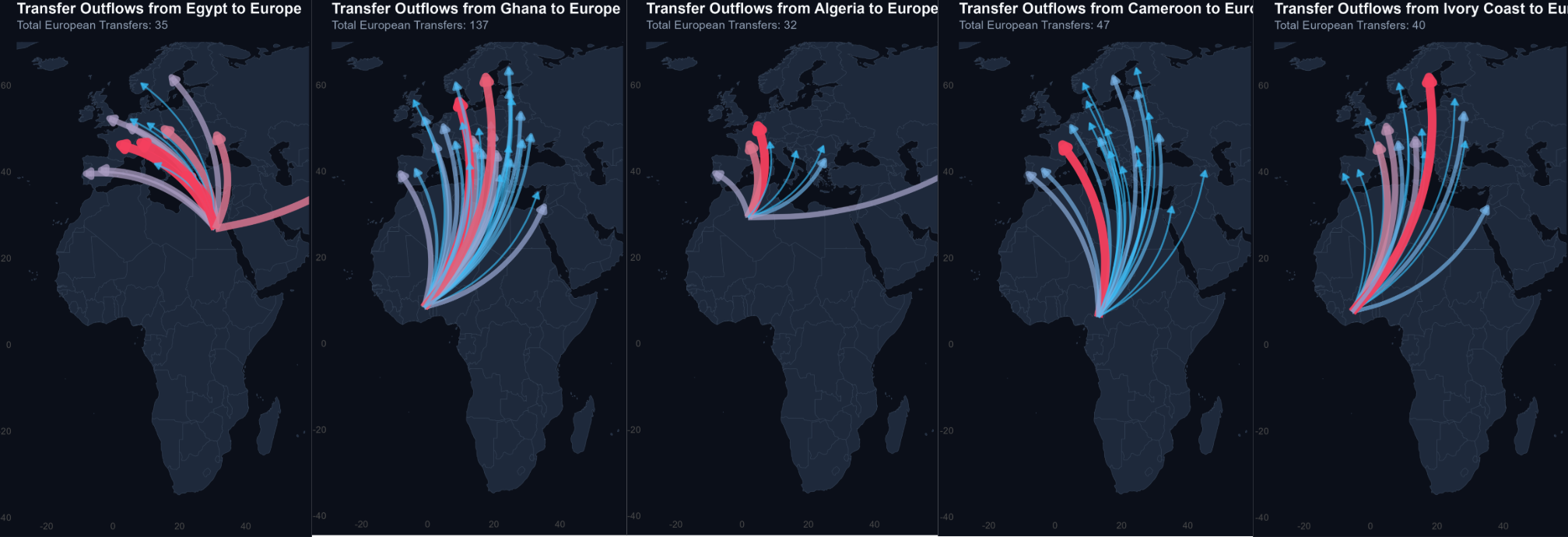
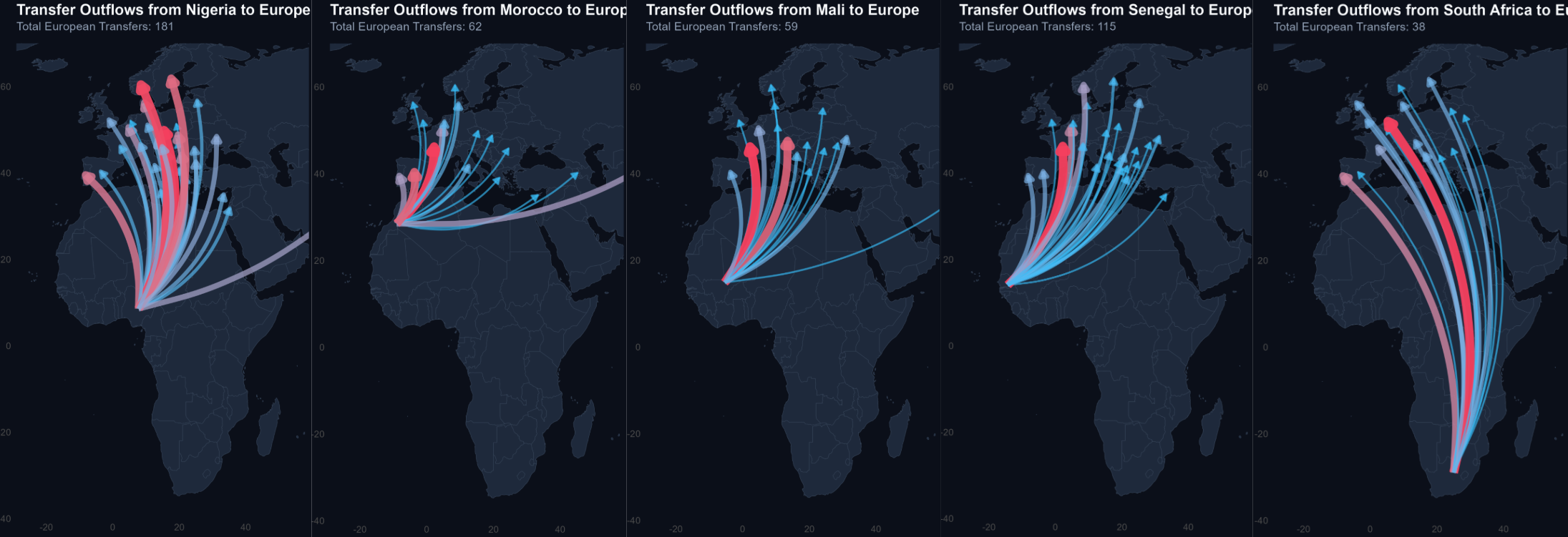
In these plots we see the top 10 sources of talent from Africa. Each plot shows the destinations to which all the players leaving that country went. Line thickness and shade correlates to numbers of transfers taken on that specific route. All arrows taken from centroids rather than club/city GPS points. Arrows leaving off Eastward represent moves to Russia.
And that’s how we end up in West Africa. This final map of the 20 most taken routes from Africa to Europe shows every single top 20 route to West African origin, all providing to western and northern Europe. Countries like Ghana, Senegal, Mali and Nigeria offer the most alluring combination of political stability, infrastructure, cost and language.
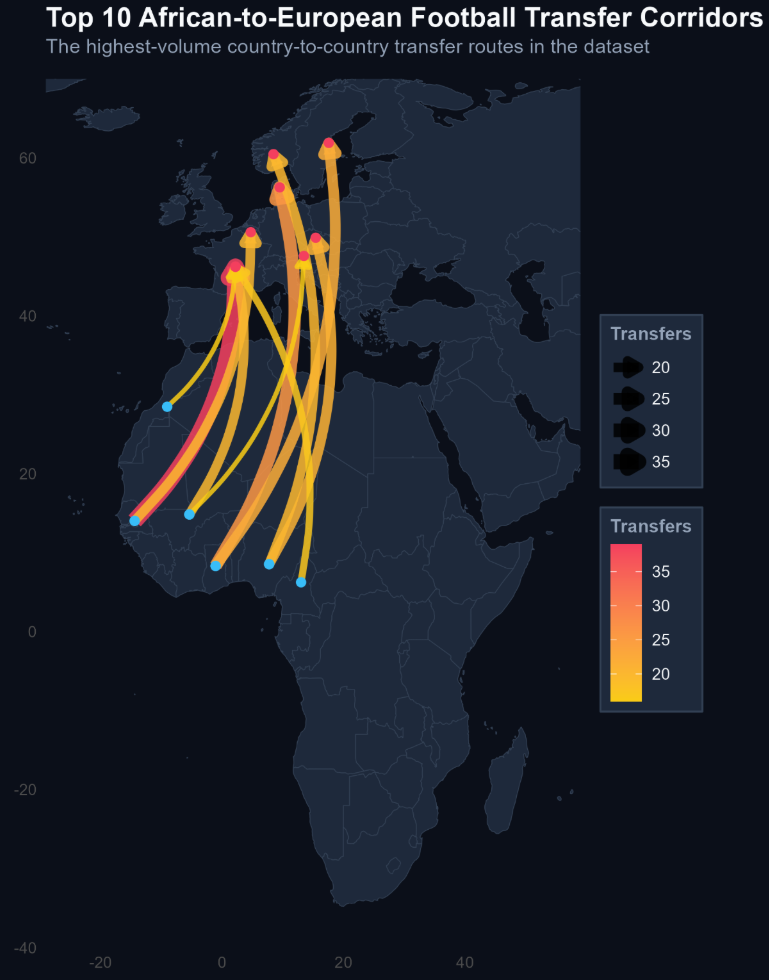
The Top 20 transfer lanes between the two continents. Colour/Thickness denotes quantity of transfers.
Why doesn’t everyone do this?
So it is an industry that’s made 1.7billion in revenue; highlight clubs like FC Metz have seen the likes of Sadio Mané and Ismaila Sarr through their doors… seems like a great deal. And for the clubs that are in, it is. The first, most obvious set of European clubs to rule out are the low-budget ones. For many smaller European nations, the wealth simply isn’t there. While a few million to set up and run an academy is the sort of money Ligue 1 sides might lose down the back of the sofa, in countries like Serbia last year’s league runners-up have only ever made 1 transfer for over 1million in their club history. It’s hard therefore to justify spending your whole club’s funds on an academy rather than 2-3 superstar record signings.
German clubs are hamstrung heavily by the 50+1 rule, regarding ownership, which plays a large role in restricting their pursuit of African programs. The huge lack of the UK and Italy on the map is largely a product of restrictions on international player slots and visas. In Serie A, teams can only have 2 non-EU players signed from foreign clubs, and those slots generally need to be saved for global talent, not used up on a couple of African Academy graduates who likely will need some time to adjust to first-team football.
The adjustment to first-team football brings us to perhaps the most important reason of all. The risk-reward is not the same for big clubs. The reward for FC Metz of earning around 50m euros in transfer fees has been enormous. It’s made the risk of investing so heavily in the structure worth it. But if you’re, say, Manchester United, who made over 750m Euros of revenue last year… the risk of investing so much time, logistical effort and money in setting up the academy is still high, but the dream of making 50m euros is not so exciting.
The problem also very heavily comes down to player skill. If we go back to where my journey began, with El Hadji Malick Diouf. He signed at 18 and walked straight into the Tromso first team, and was sold on within a year. It then took him 2 more seasons in Czech football to be ready for his first Premier League action. If a Premier League club had been funding Mawade Wade, they would’ve had to try and find a way to get 3 years of elite European football experience into his legs before he was of any use to them. Even when you put aside the problems of limited loan allocations and visa problems… Why would they want to spend money on waiting so long, when many of these academy players never get past the level of being modest Czech or Norwegian league players?
All the reasons outlined above sum to having no real involvement in this extraction process by any of the world’s 20 richest clubs, any teams in the world’s most-watched league, no German or Italian involvement either and relatively low engagement in Spain too. And that’s how the tens of thousands of kids in African Academies remain out of view.
Chelsea nearly signed Lamine Camara this summer. We got the story of AS Monaco tussling over negotiations with Chelsea, and we miss that Camara, like Pape Matar Sarr, Sadio Mané, Ismaila Sarr, Papiss Cissé and Diafra Sakho… all came from Generation Foot. They all lived in bunk beds, did school and football in equal parts at one facility, and threw their entire lives at the promise of a plane ticket to FC Metz, got it, and never looked back.
Without getting too wishy-washy about it, I think it’s a shame. I think fans should know, when they watch their players play, the sacrifices and routes they took to make it. I want to hear Camara tell us about his friends who didn’t make it out of Senegal, Diouf to tell us what the food was like at Mawade Wade, and Amadou Haidara to tell us what it was like playing in Bamako and getting the news that he’d been offered a short-term trial at RB Salzburg.
I feel that surely a better understanding of what we are watching and consuming can only be a good thing.